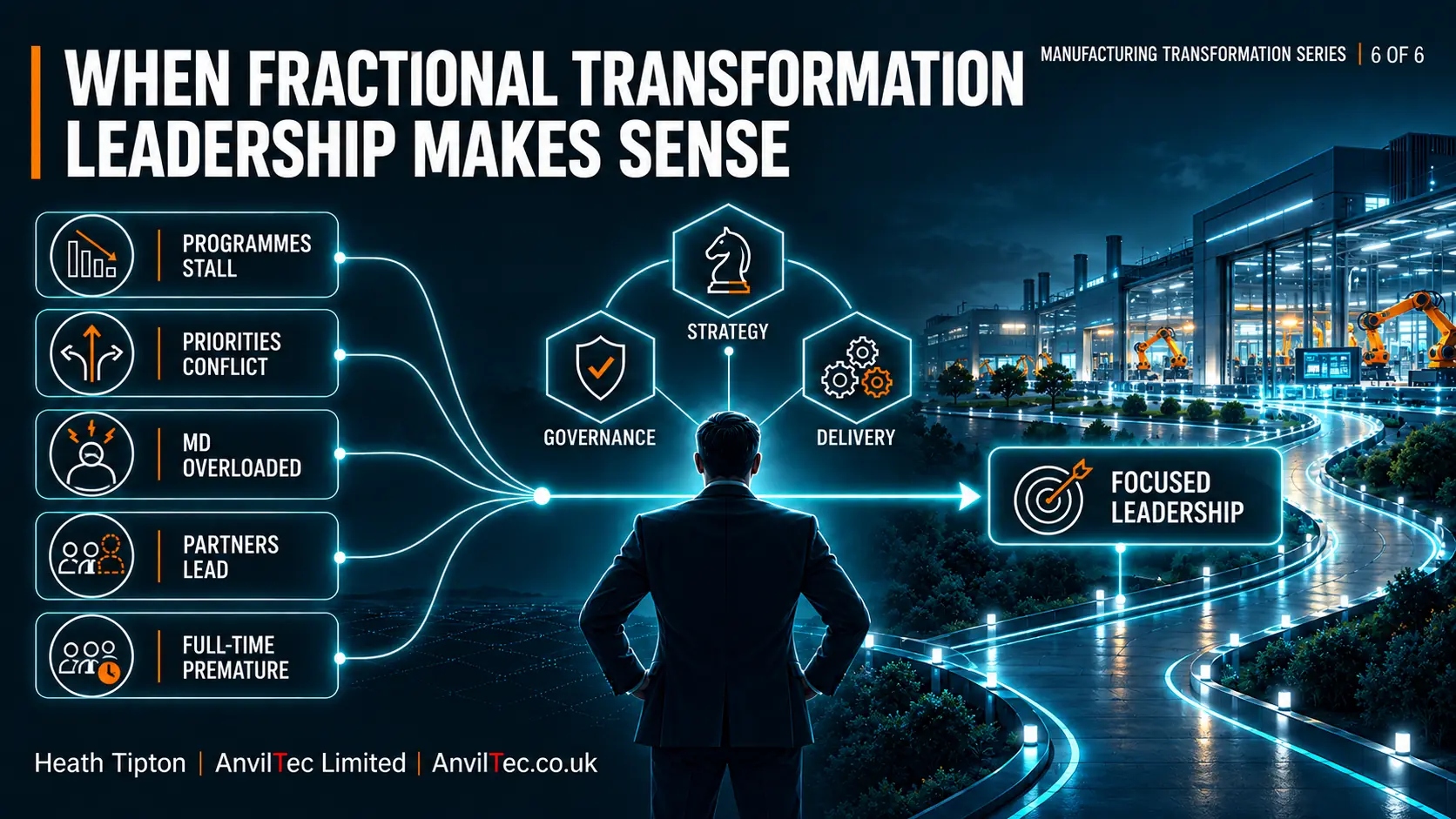
Many manufacturing SMEs reach a point where important change needs senior leadership, but a permanent transformation director is not yet justified.
Typical triggers
- Several improvement or systems initiatives compete for the same people.
- ERP, PLM or operational programmes are beginning to stall.
- The managing director is carrying too many cross-functional decisions.
- Implementation partners lack a strong client-side counterpart.
- Growth, acquisition or investment has exposed operating-model weaknesses.
- The business is preparing to scale, refinance or sell.
What the role should provide
- Translate strategic priorities into one transformation agenda.
- Establish governance and independent programme control.
- Align operations, engineering, commercial, finance and technology.
- Challenge suppliers and investment decisions constructively.
- Maintain focus on measurable business outcomes.
- Build internal capability so the company does not become dependent on the role.
The arrangement can flex with the programme: more intensive during diagnosis and mobilisation, then reducing as accountable internal leaders take control.
The test is whether the cost and risk of continuing without focused leadership is now greater than the investment required.
Define the mandate before defining the days
A fractional role should not be measured only by time allocation. It needs an explicit mandate: the outcomes to own, decisions the role can make, governance relationships, supplier authority and the internal leaders who remain accountable for operations. The required intensity can then change across diagnosis, mobilisation and delivery.
- A written outcome and decision mandate.
- Direct access to the managing director and functional leaders.
- One integrated view of priorities, resources and dependencies.
- Authority to challenge suppliers and escalate evidence.
- A defined approach to capability transfer and eventual transition.
What the first month should achieve
The first month should establish the fact base, simplify the agenda and create a small number of controlled priorities. It should make resource constraints visible, define the governance rhythm and identify the decisions that only the leadership team can make. Starting delivery without this alignment simply gives the existing confusion more momentum.
- Confirm strategic and operational outcomes.
- Assess the portfolio, risks and delivery capacity.
- Stop or pause activity that lacks ownership or value.
- Establish executive governance and reporting.
- Mobilise the first evidence-led delivery priorities.
Know when the model should change
Fractional leadership should reduce dependency, not create it. As internal leaders take ownership and the programme becomes stable, the engagement can reduce, move into targeted assurance or transition to a permanent role. That transition should be designed from the beginning, supported by clear documentation, decision rights and coaching.
The best fractional leader creates control quickly and leaves stronger leadership capability behind.