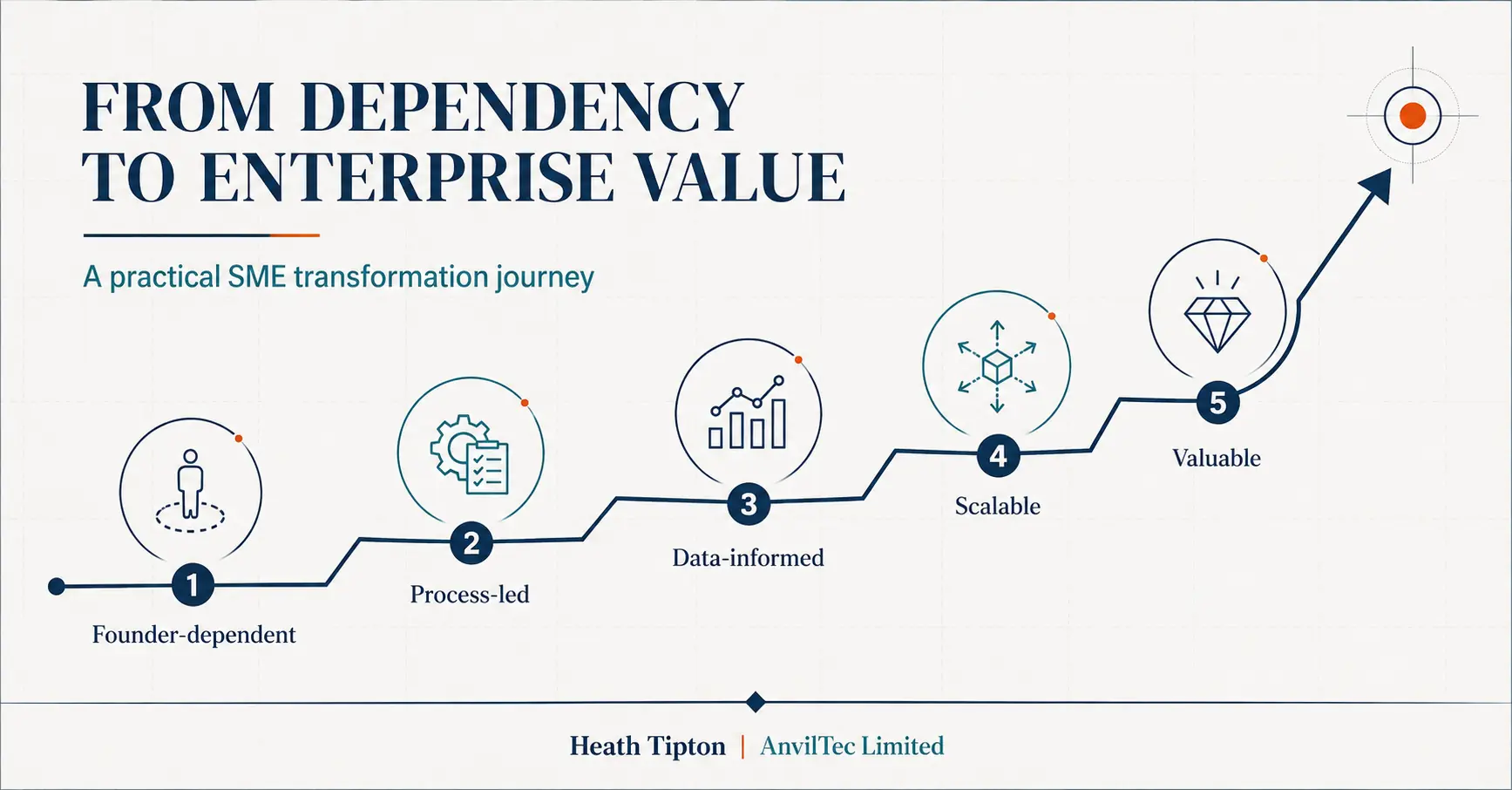
A profitable company is not necessarily a transferable company. If client relationships, pricing decisions, delivery knowledge, approvals and problem-solving all depend on the founder, a buyer sees concentration risk—not just value.
Reducing founder dependency should begin well before a sale process starts. The objective is not to remove the founder from the business, but to ensure the company performs consistently without their daily intervention.
Build capability that belongs to the company
- Transfer key client relationships to a broader leadership team.
- Document critical processes, commercial rules and delivery knowledge.
- Delegate decisions through clear authorities and controls.
- Build reliable management information that does not rely on instinct.
- Develop managers who can lead people, performance and customers.
- Demonstrate stable revenue, service quality and cash conversion when the founder steps back.
This strengthens the business whether or not a sale ultimately takes place. It improves resilience, creates management capacity and gives the owner more choice over their future role.
Buyers pay more confidently for capability that remains when one individual leaves.
How a buyer experiences founder dependency
Dependency becomes visible during due diligence. Forecasts cannot be explained without the founder, customer relationships have no second point of contact, pricing sits outside documented rules and operational issues are resolved through personal intervention. The business may be profitable, but the buyer must price the risk of transferring that performance.
- Revenue is concentrated in relationships held personally by the founder.
- Commercial decisions lack documented authority or supporting data.
- Key delivery knowledge is held by individuals rather than processes and systems.
- Management reporting requires extensive interpretation or reconciliation.
- The leadership team escalates routine decisions rather than owning results.
Build evidence of transferability
A transferable business can demonstrate that customers are managed, work is controlled and performance is understood through repeatable organisational capability. That evidence should exist over time; changing the organisation immediately before a sale may look cosmetic and can create execution risk.
- Define the decisions that must move away from the founder.
- Transfer customer and supplier relationships with a structured handover.
- Create clear management accountabilities and delegated authorities.
- Standardise the critical processes that protect revenue, margin, cash and service.
- Produce reliable management information without manual founder interpretation.
- Test resilience through planned periods when the founder steps back.
Track both freedom and enterprise value
Measures should include the proportion of revenue with more than one senior relationship, decisions made within delegated authority, process compliance, forecast accuracy, management-team capacity and the number of operational issues requiring founder intervention. The same work that improves sale readiness also gives the owner greater choice over pace, role and timing.
Founder independence is not an exit-only initiative. It is a practical measure of organisational maturity.