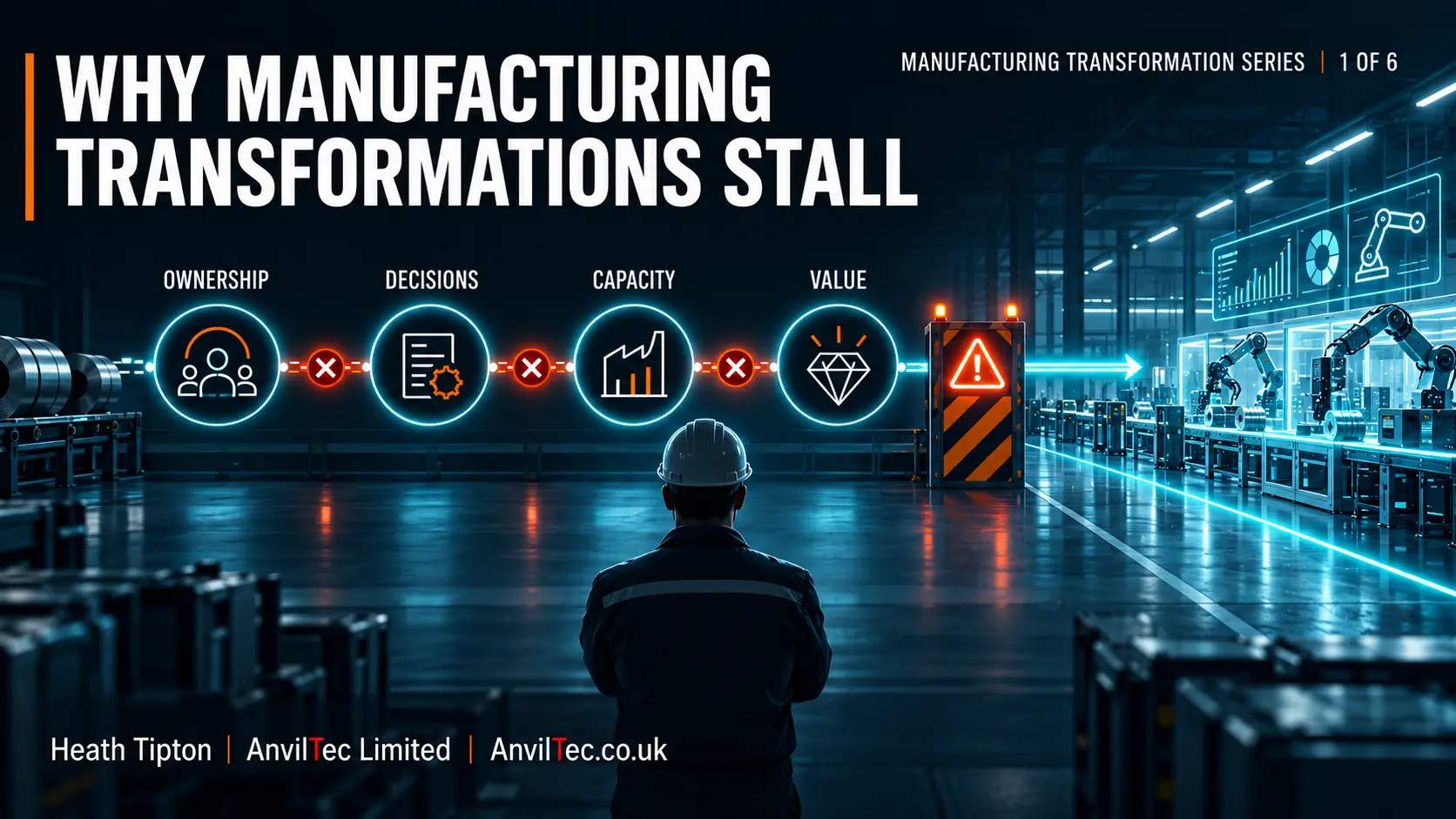
Manufacturing transformations rarely fail because the original ambition was too small. They stall because the business cannot convert that ambition into coordinated decisions and controlled delivery.
The warning signs
- No single executive owns the outcome across functions.
- Operations, engineering, IT and finance optimise different priorities.
- The implementation partner begins making business decisions by default.
- Programme teams report activity rather than operational improvement.
- Unresolved design decisions accumulate behind an apparently green plan.
- Key people deliver transformation alongside an already full operational role.
- Benefits are discussed without a credible baseline or accountable owner.
These are not project-management problems alone. They are symptoms of weak transformation governance.
Keep three things connected
- Strategic intent—the business outcomes that justify the investment.
- Operating-model decisions—how people, processes, data and responsibilities must change.
- Disciplined delivery—clear ownership, evidence-based reporting and timely escalation.
The answer is decisive sponsorship, integrated governance and relentless focus on business value—not another layer of reporting.
Stalling usually begins before the plan turns red
The earliest signals are behavioural. Decisions move to the next meeting, functional teams optimise their own work, suppliers define the agenda and programme reporting becomes more positive as confidence declines. By the time milestones visibly slip, the underlying ownership and design problems may have existed for months.
- Benefits have no operational owner or baseline.
- Process decisions are delegated to a software or implementation partner.
- Engineering, operations, supply chain and finance use different definitions of readiness.
- Data activity is treated as migration work rather than business ownership.
- Subject-matter experts are allocated in principle but unavailable in practice.
- Escalations describe symptoms without identifying the decision required.
Recover control through evidence
Recovery should begin with a short independent review of value, design, delivery and readiness. The objective is not to produce another status report. It is to establish what is true, which assumptions no longer hold, what must be decided and whether the current scope and sequence are still credible.
- Reconfirm the outcomes and identify which benefits remain credible.
- Map the unresolved cross-functional process and data decisions.
- Test the critical path against real resource availability and dependencies.
- Separate configuration progress from operational readiness.
- Reset governance around named decisions, evidence and accountable owners.
Protect production while changing the system
Manufacturing transformation must respect the operating rhythm of the plant. Cutover, training, inventory, supplier readiness, maintenance windows and engineering change cannot be governed as isolated project tasks. They need one integrated operational-readiness view, supported by rehearsals and clear fallback decisions.
A stalled programme rarely needs more reporting. It needs a shared fact base, decisive ownership and a credible sequence for returning to control.