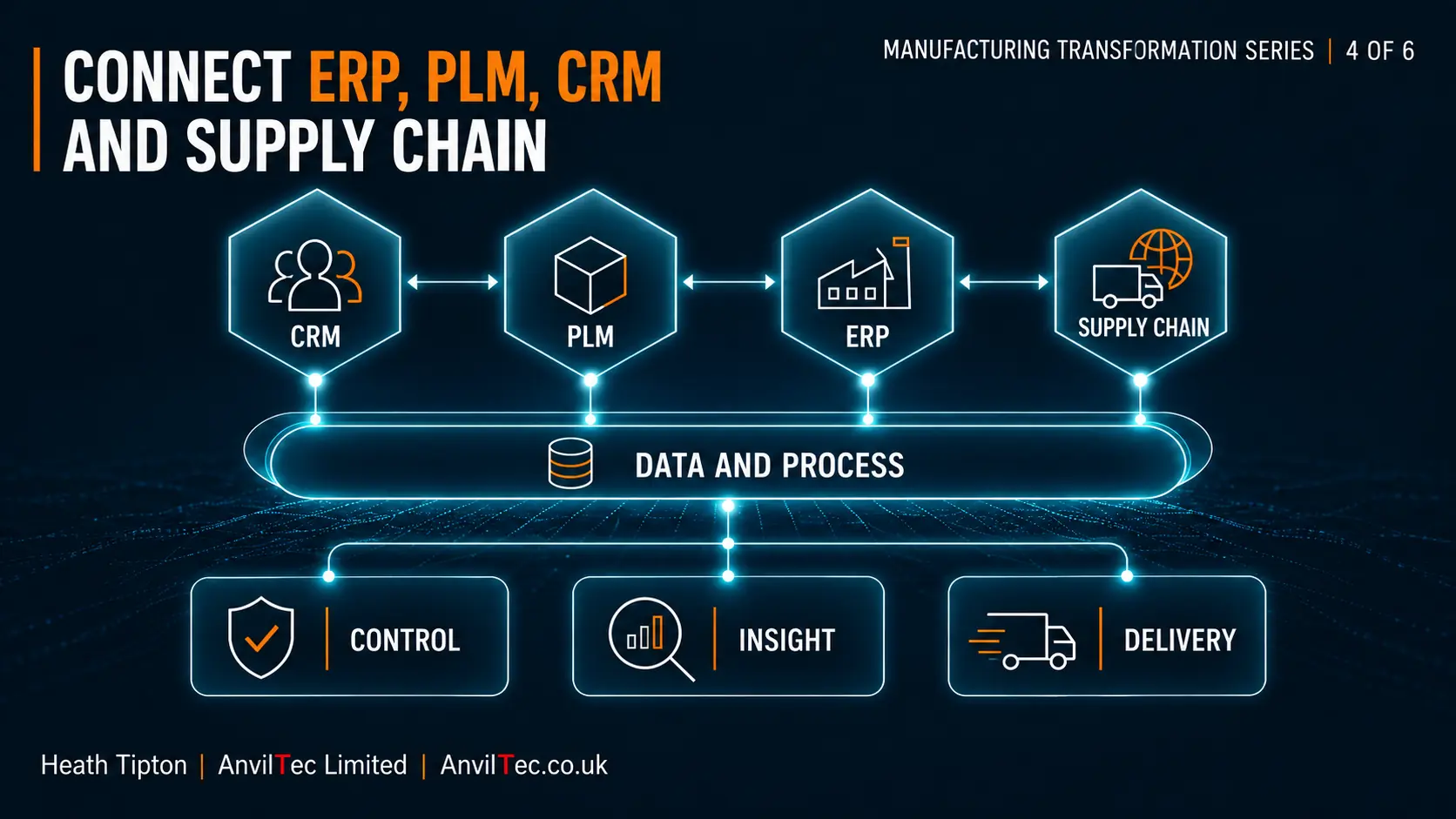
A customer requirement can begin in CRM, become a product definition in PLM, create demand in ERP and trigger activity across suppliers and manufacturing. In many businesses, however, those systems behave as separate islands.
The gaps are filled with spreadsheets, email, re-keying and local knowledge. Product changes arrive late, commercial commitments are disconnected from capacity, and management information requires repeated reconciliation.
Four principles for a controlled digital thread
- Clear system ownership—define which platform owns customers, products, bills of material, demand, inventory and financial data.
- Common definitions—agree identifiers, statuses and business rules before building integrations.
- Controlled hand-offs—make approvals, changes and exceptions visible as information moves between functions.
- End-to-end measures—track performance across the complete value stream, not only within departments.
For an engineering or manufacturing business, this connected digital thread supports quotation accuracy, product introduction, change control, production planning, traceability and customer delivery.
Integration is valuable when it removes delay and improves decisions—not simply because two systems can exchange data.
Start with the business object—not the interface
Integration design often begins with application interfaces. A more reliable starting point is the lifecycle of the information the business depends on: customer, product, quotation, bill of material, change, demand, supplier, inventory, project and financial result. For each object, define ownership, authoritative source, status model and the events that should move information to another system.
- CRM owns the qualified customer opportunity and commercial relationship.
- PLM owns the controlled product definition and engineering change.
- ERP owns demand, supply, inventory, production and financial execution.
- Supply-chain processes connect external commitments to internal capacity and product status.
- Management information reconciles these flows around agreed definitions and timing.
Govern exceptions deliberately
The normal flow matters, but operational risk often sits in exceptions: urgent engineering changes, substituted materials, manual pricing, incomplete product data or customer commitments made before capacity is understood. The target design should identify these scenarios, define authority and make the resulting risk visible.
Measure the end-to-end result
Departmental measures can hide failure between systems. Useful cross-functional measures include quotation-to-order time, engineering-change cycle time, schedule stability, first-time-right product data, supplier confirmation, inventory accuracy and on-time customer delivery. These measures show whether the digital thread is improving the business rather than merely moving data.
- Agree business ownership and authoritative sources.
- Standardise identifiers, statuses and definitions.
- Design the end-to-end process and exception controls.
- Prioritise interfaces by business value and operational risk.
- Test information flow with real scenarios before scaling.
The digital thread is an operating model supported by technology—not an integration diagram.