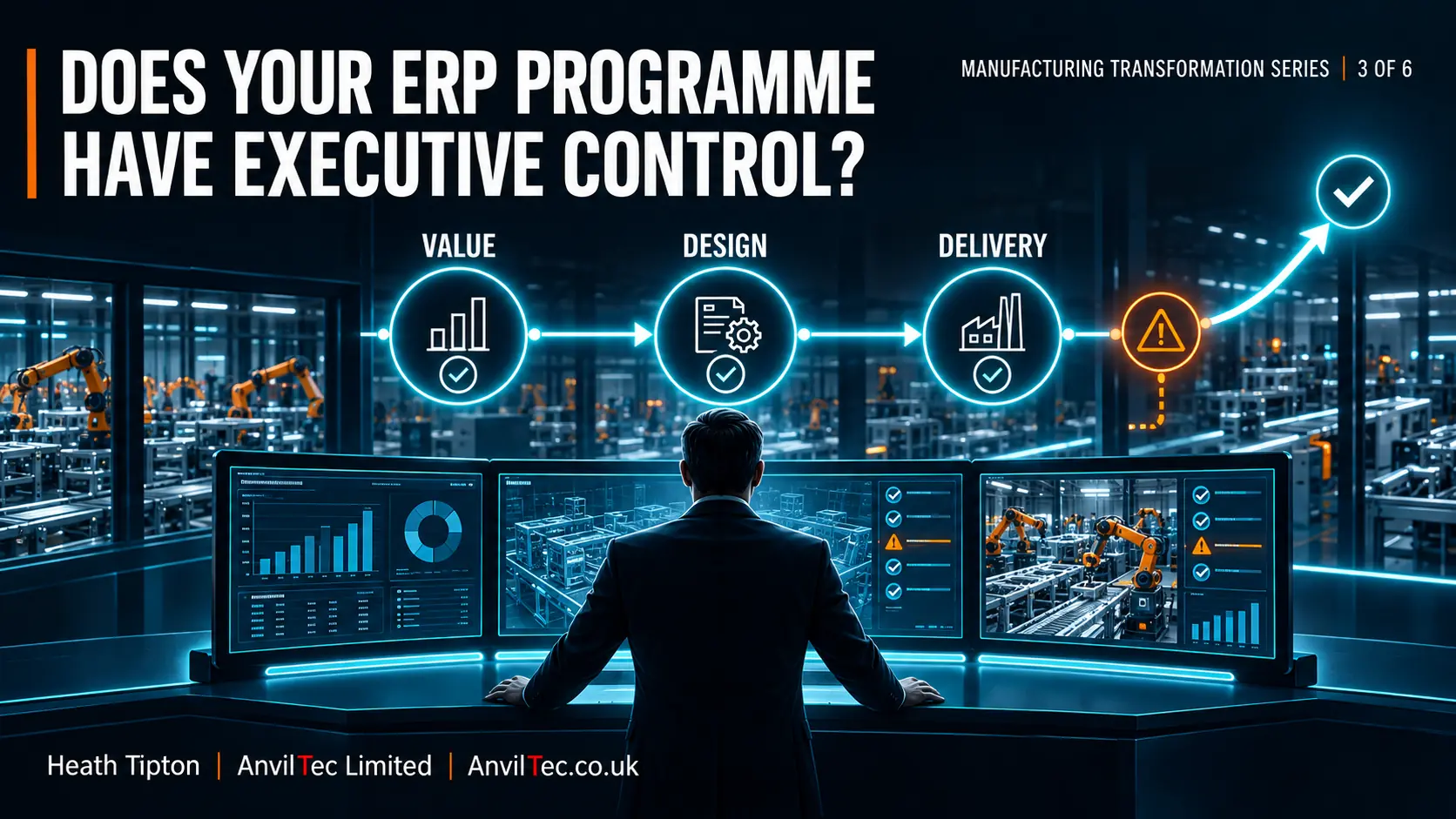
An ERP steering committee does not automatically provide ERP governance. Executive control exists only when leaders can see the real position, make timely decisions and hold named people accountable for operational outcomes.
When governance becomes procedural
- The sponsor attends stage gates but not difficult design decisions.
- Status is reported by the implementation partner without an independent client view.
- Risks remain open because escalation feels like admitting failure.
- Process owners describe configuration but not the expected business benefit.
- Scope decisions ignore their effect on operations, data or adoption.
- Readiness is based on completed tasks rather than evidence the business can operate.
- The programme is measured against go-live, not performance after go-live.
Connect three levels of governance
- Value governance—are expected benefits still credible and owned?
- Design governance—are process, data and control decisions coherent across functions?
- Delivery governance—are milestones, dependencies, risks and readiness supported by evidence?
If the programme is green but leadership confidence is falling, the reporting may be measuring the wrong things.
What an executive control pack should contain
A useful control pack should enable decisions, not merely record activity. It should show the relationship between business outcomes, process and data design, the integrated plan, operational readiness and the decisions required from leadership. Every red or amber item should state the consequence, owner, decision date and recovery action.
- Benefit baselines and named operational owners.
- Cross-functional design decisions and the consequences of delay.
- Integrated milestones across client teams, partners and suppliers.
- Data quality, testing, cutover and adoption evidence.
- Resource capacity and critical dependencies.
- A short decision log with due dates and accountable executives.
Maintain an independent client-side view
Implementation partners should report their work transparently, but they should not be the sole source of programme assurance. The client needs its own view of whether process owners have accepted the design, whether data is usable, whether people can operate the new model and whether expected benefits remain achievable.
This is particularly important where commercial incentives reward the completion of configuration or contractual milestones. Those measures can be valid while the organisation remains unready to operate.
Questions for the next steering committee
- Which business outcome is most at risk and who owns it?
- What decision has been open longest and what is the cost of further delay?
- Which readiness claim is supported by tested evidence rather than task completion?
- Where does the implementation partner’s view differ from the client’s?
- What must be true 30 days after go-live for the programme to be considered successful?
Executive control means seeing the real position early enough to change it.